Being diagnosed with macular degeneration can feel overwhelming, especially when everyday tasks like reading, recognizing faces, driving, or enjoying hobbies become more difficult. While there is currently no cure for age-related macular degeneration (AMD), many people are surprised to learn that there are numerous low vision solutions available to help maximize their remaining vision.
At EYE Invision, our goal is not simply to measure your eyesight—we help you find practical solutions that allow you to continue doing the activities that matter most.
Macular degeneration primarily affects your central vision, making it difficult to see fine details while often leaving your side (peripheral) vision intact. Many people notice:
- Difficulty reading
- Faces becoming blurry
- Trouble recognizing street signs
- Increased glare
- Reduced contrast
- Difficulty adapting between bright and dark environments
Although eyeglasses cannot reverse retinal damage, specialized low vision devices and customized optical solutions can often make everyday tasks easier. Vision rehabilitation can help people with AMD maintain independence and quality of life.
Can Special Lens Tints Help Macular Degeneration?
One of the most overlooked tools in low vision rehabilitation is the use of therapeutic lens tints.
Unlike ordinary sunglasses, therapeutic filters are selected to improve visual comfort while maximizing the amount of useful vision that reaches the retina. The goal is not simply to make everything darker—it is to reduce uncomfortable glare, improve contrast, and help patients function more comfortably in different lighting environments.
Patients frequently report improvements with activities such as:
- Reading outdoors
- Walking on bright sidewalks
- Shopping under fluorescent lighting
- Watching sporting events
- Gardening
- Spending time at the beach
Every patient’s visual system is different. During a low vision evaluation, multiple filter colors and transmission levels can be demonstrated to determine which provides the greatest functional benefit.
Many patients purchase dark sunglasses hoping they will improve their vision.
Unfortunately, darker is not always better.
In some cases, lenses that are too dark reduce the amount of light needed for optimal retinal function and can actually make vision more difficult.
Customized precision filters are selected based on:
- Contrast enhancement
- Light sensitivity
- Visual comfort
- Indoor versus outdoor use
- Individual visual goals
Some patients benefit from amber or brown filters, while others may prefer gray, plum, or other specialty tints depending on their symptoms and activities.
Reading is one of the first activities affected by macular degeneration.
Many patients benefit from:
- Handheld magnifiers
- Stand magnifiers
- Illuminated magnifiers
- High-add reading glasses
- Electronic video magnifiers
The appropriate device depends on your remaining vision, working distance, and reading goals. High-powered reading glasses, telescopic systems, and magnification can be valuable tools when prescribed appropriately.
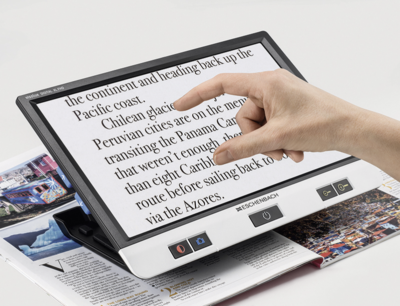
Electronic magnifier
Modern electronic devices can dramatically improve independence.
These include:
- Portable electronic magnifiers
- Desktop video magnifiers
- OCR text-to-speech devices
- Tablets and smartphones with accessibility features
- Wearable electronic visual aids
Electronic magnification often provides adjustable magnification, contrast enhancement, reverse contrast, and image optimization beyond what conventional optics can achieve.
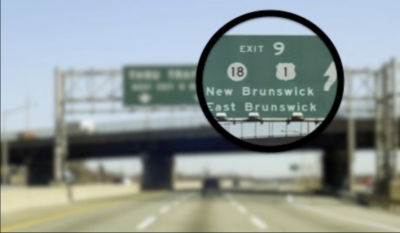
Vision for Driving
For patients who struggle seeing signs, television, presentations, or sporting events, low vision telescopes may improve distance vision.
Depending on your needs, options include:
- Handheld telescopes
- Spectacle-mounted Galilean telescopes
- Bioptic telescopes
- Electronic wearable systems
Each solution is customized based on your remaining vision and daily activities.
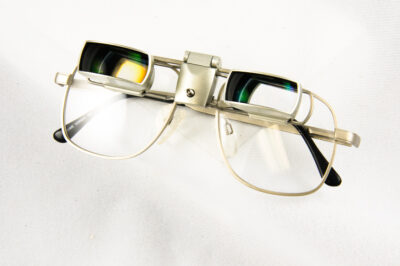
Special telescope glasses
Lighting is often just as important as magnification.
Simple adjustments may include:
- Bright LED task lighting
- Adjustable reading lamps
- Reducing glare from windows
- Increasing contrast around the home
- Positioning lights behind the shoulder rather than directly in front
These changes can significantly improve comfort during reading, cooking, hobbies, and other daily tasks.
At EYE Invision, every low vision evaluation is individualized.
Your examination may include:
- Contrast sensitivity testing
- Glare evaluation
- Therapeutic lens tint demonstration
- Magnifier assessment
- Telescope evaluation
- Electronic device recommendations
- Lighting recommendations
- Home and workplace adaptations
Our goal is to help you maximize your remaining vision—not simply prescribe stronger glasses.
Can glasses cure macular degeneration?
No. Glasses cannot reverse retinal damage caused by macular degeneration. However, specialized low vision glasses, magnifiers, telescopes, and therapeutic lens filters can often improve comfort and help you make better use of your remaining vision.
Do therapeutic lens tints restore vision?
No. Therapeutic filters do not restore damaged retinal tissue. Instead, they may reduce glare, improve contrast, and increase visual comfort for some patients.
Is every tint the same?
No. Different colors and light transmission levels affect vision differently. The best filter depends on your specific visual needs, lighting conditions, and activities.
Will I need more than one pair?
Many patients benefit from separate indoor and outdoor filters, allowing them to optimize vision under different lighting conditions.