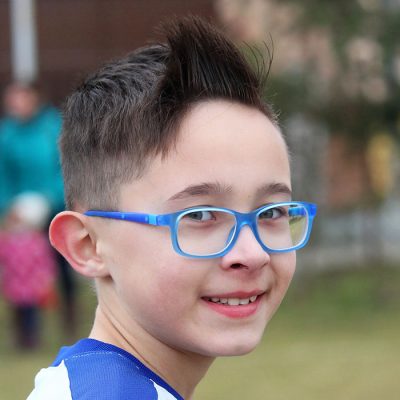
Many children do not realize their vision is blurry.
Because vision changes often happen gradually, children may assume everyone sees the world the same way they do.
As a result, parents are often the first to notice subtle signs that their child may need glasses.
Here are five common signs to watch for.
1. Squinting
Children frequently squint when trying to improve blurry vision.
Squinting temporarily changes how light enters the eye and may make distant objects appear clearer.
If your child regularly squints while watching television or looking at distant objects, an eye examination may be recommended.
Squinting is one of the most common signs of childhood nearsightedness. Learn more about What Is Childhood Nearsightedness?
2. Sitting Close to the TV
Many parents notice their child sitting unusually close to the television.
While this behavior does not damage the eyes, it may indicate difficulty seeing clearly at a distance.
Children who sit close to the television may be compensating for blurry distance vision associated with myopia.
3. Frequent Headaches
Vision problems can sometimes contribute to headaches, especially after reading, schoolwork, or prolonged screen use.
4. Holding Books Very Close
Children with nearsightedness often prefer to hold books, tablets, or phones close to their face.
5. Difficulty Seeing the Board at School
Many children do not tell parents they cannot see the board clearly.
Teachers may notice a child moving closer to the front of the classroom or struggling to read information from a distance.
When Should Parents Schedule an Eye Exam?
If your child demonstrates any of these signs, a comprehensive pediatric eye examination can help determine whether vision correction or treatment is needed.
Related Reading
- Pediatric Eye Care
- Myopia Management
- Is My Child’s Prescription Getting Worse Every Year?
- Orthokeratology (Ortho-K) for Children (coming soon)
- Why Is My Child Squinting? (coming soon)
- Why Is My Child Sitting So Close to the TV? (coming soon)
Could Myopia Be Causing These Symptoms?
Many of these signs are associated with childhood nearsightedness (myopia). Understanding how myopia develops can help parents recognize problems early and protect their child’s long-term vision.